R36S Hacking
-
Updated November 2026: this page is now about Linux 7.3, U-Boot v2026.10 and
Buildroot 2026.08.
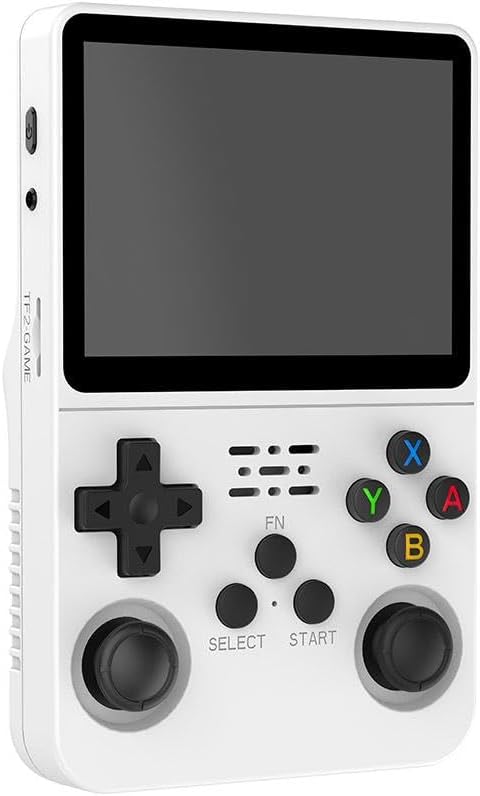 The R36S is a hand-held game console that you can buy online.
This page is about how to use the R36S as a Linux platform for your own software. To use
it as a game console, use ArkOS
or one of
the other custom firmware
systems.
It has the following basic hardware:
-
RK3326 processor
- Quad-core ARM Cortex-A35 CPU (64-bit)
- Mali-G31 GPU
- Up to 1.5 GHz. This software runs the CPU at a maximum of 1.3 GHz.
-
Datasheet
- 1GB DDR3L
- 640*480 3.5-inch LCD
- 3200 mAh Battery (Replaceable) (JST connector)
- Built in mono speaker
- 2x TF/microSD Slot
- 2x USB-C connectors (1x data, 1x charge)
- Dual analog joysticks, direction pad and 10 additional buttons
Labeled internal photo
Hardware details
The R36S is very similar to the
ODroid Go Super. Or the
ANBERNIC RG351V
- LCD: 640x480 MIPI DSI panel with an NV3051D controller (no datasheet).
GPIO Assignments
Note: Pins that are using an alternative function may not be listed here yet.
| Bank |
Pin |
Function |
| GPIO0 |
PA3 |
DWMMC Card Detect |
| GPIO0 |
PB3 |
PMIC DC Detect |
| GPIO0 |
PB7 |
Rumble Motor/Vibrator ? |
| GPIO0 |
PB15 |
PWM0 - Attached to Joypad ? |
| GPIO0 |
PC0 |
PWM1 - LCD Backlight |
| GPIO0 |
PC1 |
Blue Heartbeat LED |
| GPIO1 |
PA2 |
Button A |
| GPIO1 |
PA5 |
Button B |
| GPIO1 |
PA6 |
Button Y |
| GPIO1 |
PA7 |
Button X |
| GPIO1 |
PB4 |
DPad Up |
| GPIO1 |
PB5 |
DPad Down |
| GPIO1 |
PB6 |
DPad Left |
| GPIO1 |
PB7 |
DPad Right |
| GPIO2 |
PA0 |
Button Volume Up |
| GPIO2 |
PA1 |
Button Volume Down |
| GPIO2 |
PA2 |
Button F3 |
| GPIO2 |
PA3 |
Button F4 |
| GPIO2 |
PA4 |
Button F5 |
| GPIO2 |
PA6 |
Button Top Left |
| GPIO2 |
PA7 |
Button Top Right |
| GPIO2 |
PB5 |
PMIC Battery Low Detect or LED? |
| GPIO2 |
PC6 |
Headphone Detect |
| GPIO3 |
PB0 |
Joypad AMux-B |
| GPIO3 |
PB1 |
Button F1 |
| GPIO3 |
PB2 |
Button Top Left 2 |
| GPIO3 |
PB3 |
Joypad AMux-A |
| GPIO3 |
PB4 |
Button F2 |
| GPIO3 |
PB5 |
Joypad AMux Enable |
| GPIO3 |
PB6 |
DWMMC (2)? Card Detect |
| GPIO3 |
PB7 |
Button Top Right 2 |
| GPIO3 |
PC0 |
LCD Reset |
Original Software Info
The unit that I purchased came with the following software version info:
-
Linux version 4.4.189 (dev@rk3326-dev) (gcc version 6.3.1 20170404 (Linaro GCC
6.3-2017.05) ) #3 SMP Wed Oct 13 23:24:26 EDT 2021
- U-Boot 2017.09-00048-ge8824042a0-dirty (Oct 07 2021 - 18:03:21 -0400)
Software
Mainline Linux and U-Boot do not support the R36S, but they support its RK3326. These
branches add the R36S:
Buildroot gets Linux and U-Boot from GitHub at fixed commits. It builds the full SD card
image from source. The image starts the Quake II demo
(Yamagi Quake II, OpenGL ES 3) at boot.
These parts operate correctly:
- The LCD, with a boot logo
- The GPU (Mesa Panfrost, OpenGL ES 3)
- Sound through the speaker (RK817 codec)
- All buttons and the two analog sticks, as one gamepad
- USB Ethernet on the USB-C data port, in U-Boot and Linux
- The battery, CPU frequency scaling and temperature sensors
- Reboot
Build Instructions
These instructions are for a Debian or Ubuntu machine on x86_64. Other Linux distributions
need similar packages.
# Install the necessary tools on your Linux machine
sudo apt update && sudo apt install build-essential git bc cpio unzip rsync file wget python3

git clone -b r36s-2026.08 https://github.com/AndreRenaud/buildroot-r36s.git
cd buildroot-r36s
make r36s_defconfig
make
The last command downloads and builds all the software. On an AMD Ryzen 9 7950X3D
(16 cores), this takes approximately 45 minutes. The result is
output/images/sdcard.img (1.6 GB). Write it to an SD card of 2 GB or larger:
sudo dd if=output/images/sdcard.img of=/dev/sdX bs=4M conv=fsync
Caution: replace /dev/sdX with the device of your SD card. Make sure
that it is the correct device. The command erases all data on it.
Note: the build downloads the id Software Quake II demo data. This data is not
free software. Its licence allows only non-commercial use, and it does not allow public
display. The image includes the licence, in
/usr/share/games/quake2/demo-license.txt. To build without the data,
disable BR2_PACKAGE_YQUAKE2_DEMO_DATA (make menuconfig).
Using the Image
-
Serial console: connect a 3.3 V serial adapter to the UART pads (see the photo). Use
1500000 baud, 8N1.
- Log in as
root. The password is root.
-
Ethernet does not start automatically. To start it, type
ip link set eth0 up && udhcpc -i eth0. Then you can connect with SSH.
-
To set the volume, type
amixer sset Master 175 (range 0 to 255). 175 is
comfortable on the speaker.
- To stop Quake II, type
/etc/init.d/S12userapp stop.
-
To try a new kernel, copy
Image and rk3326-r36s.dtb to
/boot, then reboot.
-
To get the U-Boot prompt, push Ctrl-C many times on the serial console while the R36S
starts.
Network boot
U-Boot can load the kernel and device tree from a TFTP server. The root filesystem stays
on the SD card. The ASIX AX88772B adapter is tested. U-Boot also has drivers for AX88179,
RTL8152 and SMSC95xx adapters.
- Connect the Ethernet adapter to the USB-C data port.
-
Copy
output/images/image.itb to your TFTP server, as
r36s/image.itb.
-
On the R36S, type these commands:
fw_setenv tftpserver 192.168.1.10
fw_setenv netboot 1
reboot
Use the IP address of your TFTP server. The network must also have a DHCP server.
If the network boot fails, U-Boot boots from the SD card. To stop the network boot, type
fw_setenv netboot.
SD Card Layout
The RK3326 has no on-board flash. Its boot ROM loads U-Boot from the SD card, then U-Boot
loads Linux.
| Offset |
Length |
Description |
| 0 |
512B |
Master boot record |
| 32kB |
~9MiB |
U-Boot |
| 10MiB |
510MiB |
FAT filesystem, mounted on /boot: Image,
rk3326-r36s.dtb, uboot.env and image.itb
|
| 520MiB |
1GiB |
ext4 root filesystem (read-write) |
U-Boot boots Image and rk3326-r36s.dtb. If this fails, it boots
image.itb (the same kernel and device tree, in one file). The U-Boot
environment is the file uboot.env. To read or change it from Linux, use
fw_printenv and fw_setenv.
Boot Time
Times after a reboot, from the reset (reboot: Restarting system):
| Event |
Time |
| U-Boot starts the kernel |
1.0 s |
| Quake II starts |
3.2 s |
| The first level is loaded |
11.3 s |
These changes make the boot fast:
-
U-Boot starts the data cache before it relocates itself. It starts the LCD panel while
it reads the kernel from the SD card.
- U-Boot reads the SD card in DDR50 mode, and loads the kernel without a FIT image.
-
The kernel configuration is small. The drivers for the boot are built in, so no modules
load at boot.
-
Before Quake II starts, udev sets up only the input, DRM and sound devices. The other
devices continue in the background.
Quake II Controls
| Control |
Action |
| Left stick, D-pad |
Move |
| Right stick |
Look (as with a mouse) |
| R2, R3 |
Fire |
| A |
Jump |
| B, L2 |
Crouch |
| L1 / R1 |
Previous / next weapon |
| Y / X |
Use item / next item |
| L3 |
Centre the view |
| Select / Start / FN |
Inventory / menu / help |
Writing Your Own Application
The script /etc/init.d/S12userapp starts Quake II as the user
player. To start your application, change this script (in Buildroot:
board/r36s/overlay/etc/init.d/S12userapp).
Use SDL with the KMS/DRM video driver and OpenGL ES. The image has SDL2 and SDL3. For an
example in Go, see
r36s-demo-app. It is in the
image, but it does not start at boot.
The buttons and the two analog sticks are one input device, "R36S Gamepad" (the
r36s-gamepad daemon). SDL3 maps it as a standard gamepad, so use the SDL
gamepad API:
| R36S |
SDL gamepad |
| A / B / X / Y |
East / South / North / West |
| L1 / R1 |
Left / right shoulder |
| L2 / R2 |
Left / right trigger |
| L3 / R3 (push the stick) |
Left / right stick |
| Select / Start / FN |
Back / Start / Guide |
| D-pad |
D-pad |
| Left / right analog stick |
Left / right stick axes |
Boot To Ebitengine
An Ebitengine game can draw directly on the LCD,
without X11 or Wayland. Ebitengine uses EGL, OpenGL ES and GBM/KMS for this (Ebitengine
v2.11, at this time the main branch). It loads these libraries when the game starts.
-
Build the game with Go for linux/arm64. Put it in the root filesystem, for example with
a Buildroot package.
-
Start the game from
S12userapp as the user player. This user
can use the display, sound and input devices.
Ebitengine uses "R36S Gamepad" as a standard gamepad. Sound plays through ALSA.
Times from the reset, for the
Flappy Gopher example:
| Event |
Time |
| U-Boot starts the kernel |
1.0 s |
| The game starts |
3.2 s |
| The first frame shows |
5.6 s |
On the first boot after you write the SD card, the first frame shows at 7.2 s. Mesa must
then compile its shaders. It keeps them for the subsequent boots.
This video shows the R36S as it boots into Flappy Gopher (this is using a CRT shader effect, so the ghosting & rounded corners are not an LCD artifact, they're part of the game):
Benchmarks & Hardware Testing
Preamble
These benchmarks are run with the performance scheduler enabled, to ensure the CPU is always
run as fast as possible. Note: Some of these benchmark programs are not built in the default
buildroot image, and will need to be manually enabled.
# echo performance > /sys/devices/system/cpu/cpu0/cpufreq/scaling_governor
# cat /sys/devices/system/cpu/cpu0/cpufreq/scaling_governor
performance
MHz
github.com/wtarreau/mhz
# mhz
count=497425 us50=19997 us250=96924 diff=76927 cpu_MHz=1293.239
Whetstone 1.2
www.netlib.org/benchmark/
# whetstone 500000

Loops: 500000, Iterations: 1, Duration: 10 sec.
C Converted Double Precision Whetstones: 5000.0 MIPS
Dhrystone 2
www.netlib.org/benchmark/
# dhrystone 50000000

Dhrystone Benchmark, Version 2.1 (Language: C)

Program compiled without 'register' attribute

Execution starts, 50000000 runs through Dhrystone
Execution ends

Final values of the variables used in the benchmark:

Int_Glob:            5
        should be:   5
Bool_Glob:           1
        should be:   1
Ch_1_Glob:           A
        should be:   A
Ch_2_Glob:           B
        should be:   B
Arr_1_Glob[8]:       7
        should be:   7
Arr_2_Glob[8][7]:    50000010
        should be:   Number_Of_Runs + 10
Ptr_Glob->
  Ptr_Comp:          -927526240
        should be:   (implementation-dependent)
  Discr:             0
        should be:   0
  Enum_Comp:         2
        should be:   2
  Int_Comp:          17
        should be:   17
  Str_Comp:          DHRYSTONE PROGRAM, SOME STRING
        should be:   DHRYSTONE PROGRAM, SOME STRING
Next_Ptr_Glob->
  Ptr_Comp:          -927526240
        should be:   (implementation-dependent), same as above
  Discr:             0
        should be:   0
  Enum_Comp:         1
        should be:   1
  Int_Comp:          18
        should be:   18
  Str_Comp:          DHRYSTONE PROGRAM, SOME STRING
        should be:   DHRYSTONE PROGRAM, SOME STRING
Int_1_Loc:           5
        should be:   5
Int_2_Loc:           13
        should be:   13
Int_3_Loc:           7
        should be:   7
Enum_Loc:            1
        should be:   1
Str_1_Loc:           DHRYSTONE PROGRAM, 1'ST STRING
        should be:   DHRYSTONE PROGRAM, 1'ST STRING
Str_2_Loc:           DHRYSTONE PROGRAM, 2'ND STRING
        should be:   DHRYSTONE PROGRAM, 2'ND STRING

Microseconds for one run through Dhrystone:    0.2
Dhrystones per Second:                      5313496.5
RamSMP
github.com/cruvolo/ramspeed-smp
# ramsmp -b 1
RAMspeed/SMP (GENERIC) v3.5.0 by Rhett M. Hollander and Paul V. Bolotoff, 2002-09

8Gb per pass mode, 2 processes

INTEGER & WRITING         1 Kb block: 31725.15 MB/s
INTEGER & WRITING         2 Kb block: 32488.16 MB/s
INTEGER & WRITING         4 Kb block: 31273.08 MB/s
INTEGER & WRITING         8 Kb block: 30794.42 MB/s
INTEGER & WRITING        16 Kb block: 28151.88 MB/s
INTEGER & WRITING        32 Kb block: 25592.05 MB/s
INTEGER & WRITING        64 Kb block: 23752.54 MB/s
INTEGER & WRITING       128 Kb block: 16333.79 MB/s
INTEGER & WRITING       256 Kb block: 4139.72 MB/s
INTEGER & WRITING       512 Kb block: 3052.76 MB/s
INTEGER & WRITING      1024 Kb block: 2687.96 MB/s
INTEGER & WRITING      2048 Kb block: 2558.74 MB/s
INTEGER & WRITING      4096 Kb block: 2495.56 MB/s
INTEGER & WRITING      8192 Kb block: 2455.05 MB/s
INTEGER & WRITING     16384 Kb block: 2444.15 MB/s
INTEGER & WRITING     32768 Kb block: 2426.52 MB/s
# ramsmp -b 2
RAMspeed/SMP (GENERIC) v3.5.0 by Rhett M. Hollander and Paul V. Bolotoff, 2002-09

8Gb per pass mode, 2 processes

INTEGER & READING         1 Kb block: 18657.31 MB/s
INTEGER & READING         2 Kb block: 19117.18 MB/s
INTEGER & READING         4 Kb block: 19015.44 MB/s
INTEGER & READING         8 Kb block: 19224.95 MB/s
INTEGER & READING        16 Kb block: 19315.28 MB/s
INTEGER & READING        32 Kb block: 14500.51 MB/s
INTEGER & READING        64 Kb block: 12601.52 MB/s
INTEGER & READING       128 Kb block: 9393.90 MB/s
INTEGER & READING       256 Kb block: 2493.20 MB/s
INTEGER & READING       512 Kb block: 2113.54 MB/s
INTEGER & READING      1024 Kb block: 2079.59 MB/s
INTEGER & READING      2048 Kb block: 2128.96 MB/s
INTEGER & READING      4096 Kb block: 2127.43 MB/s
INTEGER & READING      8192 Kb block: 2127.84 MB/s
INTEGER & READING     16384 Kb block: 2128.69 MB/s
INTEGER & READING     32768 Kb block: 2129.91 MB/s
# ramsmp -b 3
RAMspeed/SMP (GENERIC) v3.5.0 by Rhett M. Hollander and Paul V. Bolotoff, 2002-09

8Gb per pass mode, 2 processes

INTEGER   Copy:      2065.59 MB/s
INTEGER   Scale:     1986.97 MB/s
INTEGER   Add:       1615.27 MB/s
INTEGER   Triad:     1580.92 MB/s
---
INTEGER   AVERAGE:   1812.19 MB/s
# ramsmp -b 4
RAMspeed/SMP (GENERIC) v3.5.0 by Rhett M. Hollander and Paul V. Bolotoff, 2002-09

8Gb per pass mode, 2 processes

FL-POINT & WRITING        1 Kb block: 32645.77 MB/s
FL-POINT & WRITING        2 Kb block: 32949.56 MB/s
FL-POINT & WRITING        4 Kb block: 32244.32 MB/s
FL-POINT & WRITING        8 Kb block: 31326.32 MB/s
FL-POINT & WRITING       16 Kb block: 28502.43 MB/s
FL-POINT & WRITING       32 Kb block: 25335.06 MB/s
FL-POINT & WRITING       64 Kb block: 22989.79 MB/s
FL-POINT & WRITING      128 Kb block: 10451.13 MB/s
FL-POINT & WRITING      256 Kb block: 4236.35 MB/s
FL-POINT & WRITING      512 Kb block: 3085.57 MB/s
FL-POINT & WRITING     1024 Kb block: 2715.68 MB/s
FL-POINT & WRITING     2048 Kb block: 2587.16 MB/s
FL-POINT & WRITING     4096 Kb block: 2512.82 MB/s
FL-POINT & WRITING     8192 Kb block: 2471.48 MB/s
FL-POINT & WRITING    16384 Kb block: 2450.66 MB/s
FL-POINT & WRITING    32768 Kb block: 2432.75 MB/s
# ramsmp -b 5
RAMspeed/SMP (GENERIC) v3.5.0 by Rhett M. Hollander and Paul V. Bolotoff, 2002-09

8Gb per pass mode, 2 processes

FL-POINT & READING        1 Kb block: 19054.87 MB/s
FL-POINT & READING        2 Kb block: 19404.67 MB/s
FL-POINT & READING        4 Kb block: 19334.34 MB/s
FL-POINT & READING        8 Kb block: 19506.71 MB/s
FL-POINT & READING       16 Kb block: 19504.42 MB/s
FL-POINT & READING       32 Kb block: 15559.88 MB/s
FL-POINT & READING       64 Kb block: 12594.27 MB/s
FL-POINT & READING      128 Kb block: 9090.03 MB/s
FL-POINT & READING      256 Kb block: 2614.38 MB/s
FL-POINT & READING      512 Kb block: 2149.01 MB/s
FL-POINT & READING     1024 Kb block: 2112.19 MB/s
FL-POINT & READING     2048 Kb block: 2148.63 MB/s
FL-POINT & READING     4096 Kb block: 2148.72 MB/s
FL-POINT & READING     8192 Kb block: 2149.29 MB/s
FL-POINT & READING    16384 Kb block: 2150.60 MB/s
FL-POINT & READING    32768 Kb block: 2149.96 MB/s
# ramsmp -b 6
RAMspeed/SMP (GENERIC) v3.5.0 by Rhett M. Hollander and Paul V. Bolotoff, 2002-09

8Gb per pass mode, 2 processes

FL-POINT  Copy:      2066.56 MB/s
FL-POINT  Scale:     1952.23 MB/s
FL-POINT  Add:       1615.04 MB/s
FL-POINT  Triad:     1246.41 MB/s
---
FL-POINT  AVERAGE:   1720.06 MB/s
Memtester
pyropus.ca./software/memtester
This is less of a benchmark and more of a sanity check that the hardware appears to be
functioning properly. This takes ~18 minutes to finish.
# memtester 500M 1
memtester version 4.5.1 (64-bit)
Copyright (C) 2001-2020 Charles Cazabon.
Licensed under the GNU General Public License version 2 (only).

pagesize is 4096
pagesizemask is 0xfffffffffffff000
want 500MB (524288000 bytes)
got  500MB (524288000 bytes), trying mlock ...locked.
Loop 1/1:
  Stuck Address       : ok
  Random Value        : ok
  Compare XOR         : ok
  Compare SUB         : ok
  Compare MUL         : ok
  Compare DIV         : ok
  Compare OR          : ok
  Compare AND         : ok
  Sequential Increment: ok
  Solid Bits          : ok
  Block Sequential    : ok
  Checkerboard        : ok
  Bit Spread          : ok
  Bit Flip            : ok
  Walking Ones        : ok
  Walking Zeroes      : ok
  8-bit Writes        : ok
  16-bit Writes       : ok

Done.
bonnie++ - v1.03e (SD card)
Performance here is quite dependant on the SD card that is installed. This benchmark shows
~34MB/s write, 53MB/s read performance.
www.coker.com.au/bonnie++
# mount /dev/mmcblk0p2 /mnt/
[ 2014.668991] EXT4-fs (mmcblk0p2): mounted filesystem e139ce78-9841-40fe-8823-96a304a09859 r/w without journal. Quota mode: none.
# df -h
Filesystem                Size      Used Available Use% Mounted on
devtmpfs                429.8M         0    429.8M   0% /dev
tmpfs                   474.5M         0    474.5M   0% /dev/shm
tmpfs                   474.5M     32.0K    474.4M   0% /tmp
tmpfs                   474.5M    100.0K    474.4M   0% /run
/dev/mmcblk0p2            6.4G      2.8G      3.3G  45% /mnt
# mkdir /mnt/bonnie
# bonnie++ -d /mnt/bonnie/ -u 0:0
Using uid:0, gid:0.
Writing with putc()...done
Writing intelligently...done
Rewriting...done
Reading with getc()...done
Reading intelligently...done
start 'em...done...done...done...
Create files in sequential order...done.
Stat files in sequential order...done.
Delete files in sequential order...done.
Create files in random order...done.
Stat files in random order...done.
Delete files in random order...done.
Version 1.03e       ------Sequential Output------ --Sequential Input- --Random-
                    -Per Chr- --Block-- -Rewrite- -Per Chr- --Block-- --Seeks--
Machine        Size K/sec %CP K/sec %CP K/sec %CP K/sec %CP K/sec %CP  /sec %CP
buildroot        2G 24834  98 33960  13 18684  14 24672  97 52645  24  2682  32
                    ------Sequential Create------ --------Random Create--------
                    -Create-- --Read--- -Delete-- -Create-- --Read--- -Delete--
              files  /sec %CP  /sec %CP  /sec %CP  /sec %CP  /sec %CP  /sec %CP
                 16 13161  98 +++++ +++ 20575  95   709  98 +++++ +++ 18645  95
buildroot,2G,24834,98,33960,13,18684,14,24672,97,52645,24,2681.8,32,16,13161,98,+++++,+++,20575,95,709,98,+++++,+++,18645,95
glmark2-es2-drm
Note: This test was run when still mid-way through kernel porting. Results may not be
accurate now. This test takes ~5m to run.
# glmark2-es2-drm
Warning: DRM_CAP_ASYNC_PAGE_FLIP not supported, falling back to 'mailbox' mode for SwapInterval(0).
=======================================================
    glmark2 2023.01
=======================================================
    OpenGL Information
    GL_VENDOR:      Mesa
    GL_RENDERER:    Mali-G31 (Panfrost)
    GL_VERSION:     OpenGL ES 3.1 Mesa 24.0.7
    Surface Config: buf=32 r=8 g=8 b=8 a=8 depth=24 stencil=0 samples=0
    Surface Size:   480x640 fullscreen
=======================================================
[build] use-vbo=false: FPS: 230 FrameTime: 4.349 ms
[build] use-vbo=true: FPS: 228 FrameTime: 4.386 ms
[texture] texture-filter=nearest: FPS: 679 FrameTime: 1.473 ms
[texture] texture-filter=linear: FPS: 668 FrameTime: 1.499 ms
[texture] texture-filter=mipmap: FPS: 694 FrameTime: 1.443 ms
[shading] shading=gouraud: FPS: 148 FrameTime: 6.803 ms
[shading] shading=blinn-phong-inf: FPS: 147 FrameTime: 6.804 ms
[shading] shading=phong: FPS: 144 FrameTime: 6.964 ms
[shading] shading=cel: FPS: 144 FrameTime: 6.975 ms
[bump] bump-render=high-poly: FPS: 49 FrameTime: 20.752 ms
[bump] bump-render=normals: FPS: 753 FrameTime: 1.329 ms
[bump] bump-render=height: FPS: 720 FrameTime: 1.390 ms
[effect2d] kernel=0,1,0;1,-4,1;0,1,0;: FPS: 554 FrameTime: 1.805 ms
[effect2d] kernel=1,1,1,1,1;1,1,1,1,1;1,1,1,1,1;: FPS: 195 FrameTime: 5.151 ms
[pulsar] light=false:quads=5:texture=false: FPS: 776 FrameTime: 1.289 ms
[desktop] blur-radius=5:effect=blur:passes=1:separable=true:windows=4: FPS: 156 FrameTime: 6.415 ms
[desktop] effect=shadow:windows=4: FPS: 440 FrameTime: 2.275 ms
[buffer] columns=200:interleave=false:update-dispersion=0.9:update-fraction=0.5:update-method=map: FPS: 43 FrameTime: 23.706 ms
[buffer] columns=200:interleave=false:update-dispersion=0.9:update-fraction=0.5:update-method=subdata: FPS: 43 FrameTime: 23.572 ms
[buffer] columns=200:interleave=true:update-dispersion=0.9:update-fraction=0.5:update-method=map: FPS: 52 FrameTime: 19.542 ms
[ideas] speed=duration: FPS: 190 FrameTime: 5.290 ms
[jellyfish] default>: FPS: 196 FrameTime: 5.127 ms
[terrain] default: FPS: 14 FrameTime: 74.175 ms
[shadow] default: FPS: 106 FrameTime: 9.457 ms
[refract] default: FPS: 12 FrameTime: 84.059 ms
[conditionals] fragment-steps=0:vertex-steps=0: FPS: 544 FrameTime: 1.839 ms
[conditionals] fragment-steps=5:vertex-steps=0: FPS: 437 FrameTime: 2.292 ms
[conditionals] fragment-steps=0:vertex-steps=5: FPS: 543 FrameTime: 1.843 ms
[function] fragment-complexity=low:fragment-steps=5: FPS: 539 FrameTime: 1.857 ms
[function] fragment-complexity=medium:fragment-steps=5: FPS: 303 FrameTime: 3.305 ms
[loop] fragment-loop=false:fragment-steps=5:vertex-steps=5: FPS: 531 FrameTime: 1.885 ms
[loop] fragment-steps=5:fragment-uniform=false:vertex-steps=5: FPS: 531 FrameTime: 1.885 ms
[loop] fragment-steps=5:fragment-uniform=true:vertex-steps=5: FPS: 317 FrameTime: 3.159 ms
=======================================================
                                  glmark2 Score: 336
=======================================================
FFMPEG video display
ffmpeg -i /tmp/video.mp4 -pix_fmt bgra -vf "transpose=2,scale=640:480" -f fbdev /dev/fb0
Audio playback
amixer sset Master 255 && curl -L -o /tmp/sample.wav https://www2.cs.uic.edu/~i101/SoundFiles/CantinaBand3.wav && aplay /tmp/sample.wav
Test Tools
The image includes these benchmark and test tools:
-
CPU and memory:
mhz, dhrystone, whetstone,
stress-ng, memtester
- SD card:
fio, bonnie++, iozone
-
Graphics:
glmark2-es2-drm, kmscube, modetest
- Input:
evtest, jstest
-
Sound and video:
aplay, speaker-test, ffmpeg